
Mental Health Blog
Lamotrigine Rash: What It Looks Like and When to Worry
How common a lamotrigine rash is, the weeks of highest risk, the signs that mean go to the ER, and what to do first.


Most rashes on lamotrigine are mild, and a serious one is rare. But no one can tell from looking at day one which kind it is. So every new rash gets a same day call to your prescriber. A rash with blisters, peeling skin, mouth or eye sores, fever or swollen glands is an emergency. Call 911 or go to the ER.
Lamotrigine, also sold as Lamictal, is a mood stabilizer used for bipolar disorder and for seizures. The FDA approves it for long term treatment of bipolar I disorder, to delay new episodes of depression or mania. The rash warning is the reason it starts so slowly. This article explains that warning in plain words, with the real numbers from the FDA label.
Our full lamotrigine guide covers what the medicine does, how it is taken and its other side effects. This article goes deep on one question people search more than almost any other about this medicine. Is this rash dangerous, and what do I do right now?
Lamotrigine Rash at a Glance
Here is the short version. The sections below explain each point.
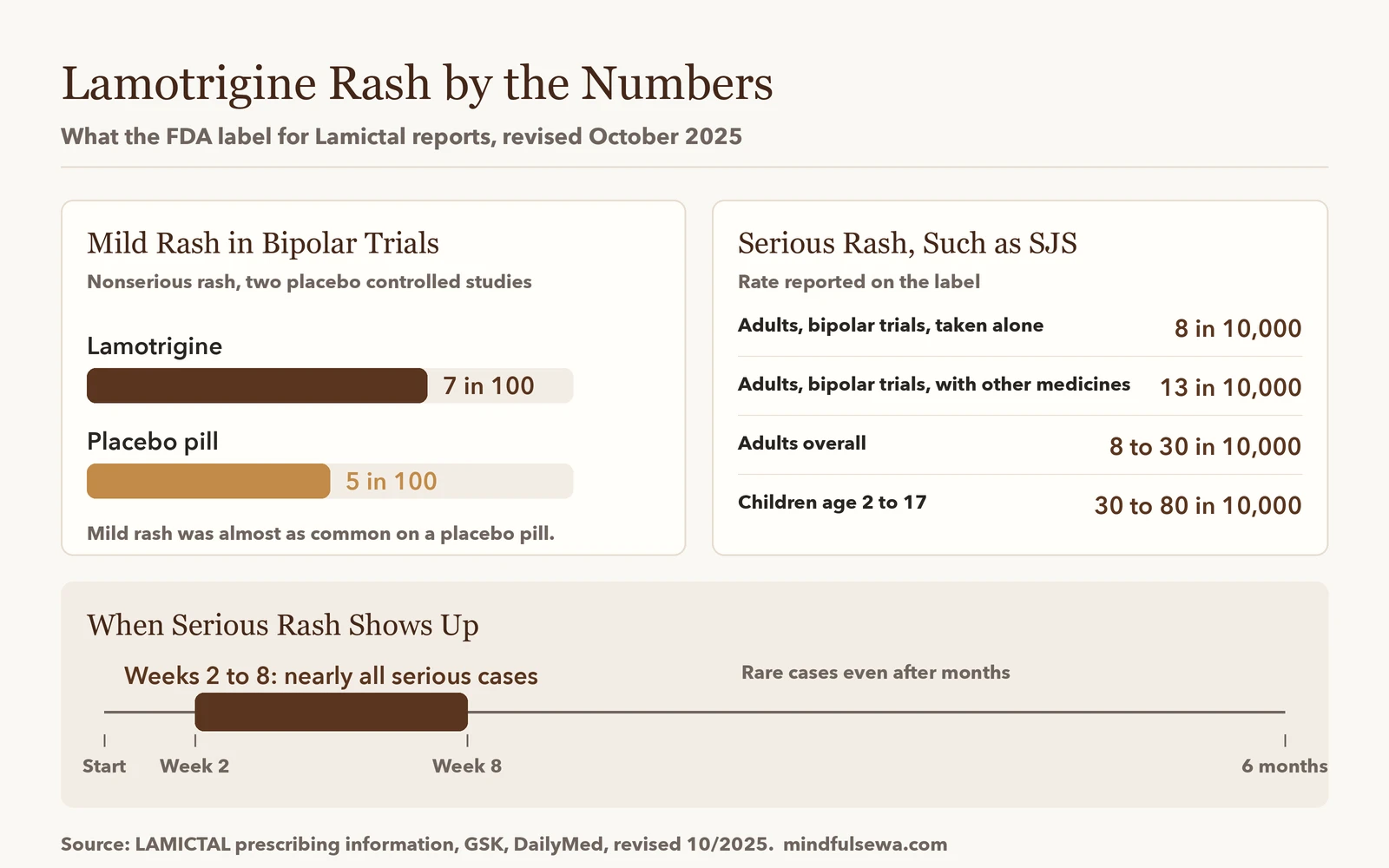
- Mild rash is fairly common. In two bipolar studies on the FDA label, 7 in 100 people on lamotrigine got a mild rash. So did 5 in 100 people on a placebo pill.
- Serious rash is rare. In adult bipolar trials it was about 8 to 13 in 10,000 people. It is more common in children.
- Weeks 2 to 8 matter most. Nearly all life threatening cases began in this window, though rare cases came later.
- Speed raises risk. A dose that starts too high or climbs too fast raises the risk. So does taking valproate (Depakote) at the same time.
- Call the same day. Your prescriber decides whether to stop the medicine. Never restart it on your own after a rash.
How Common Is a Lamotrigine Rash, Really?
You will see "about 10 percent" all over the internet. The FDA label for Lamictal gives a clearer picture. In two placebo controlled bipolar studies, 7 percent of people on lamotrigine had a nonserious rash. On a sugar pill, 5 percent did. That second number matters. Some rashes during treatment come from something else, like a new soap, a virus or a sunburn.
Serious rash is a different story. The label puts it at about 0.08 to 0.3 percent of adults, or 8 to 30 in 10,000. In the bipolar and mood disorder trials, it was 0.08 percent with lamotrigine taken alone and 0.13 percent when it was added to other medicines. No one died in those trials, though rare deaths have been reported since the drug came to market.
Children carry more risk. The label gives a rate of about 0.3 to 0.8 percent for ages 2 to 17. That is why families of teens on lamotrigine should know the warning signs as well as the teen does.
The rates also dropped once dosing changed. A 2005 review in Epilepsy Currents explains that after the maker lowered the starting doses in 1993, serious rash reports fell. Slow dosing is the main safety tool, and it works.
What a Lamotrigine Rash Looks Like
A mild rash often looks like small red spots or flat red patches, sometimes itchy, sometimes in hives. You feel well otherwise. There is no fever, no blistering and no pain in the skin.
A serious rash tends to come with other signs. The FDA Medication Guide and MedlinePlus list the ones to act on right away.
- Blistering or peeling skin, or skin that looks raw.
- Painful sores in the mouth, around the eyes, in the nose or on the genitals.
- Fever, swollen glands or a flu like feeling along with the rash.
- Hives or swelling of the face, lips or tongue.
- A dark red or purple rash that spreads fast.
The worst of these reactions has a name, Stevens-Johnson syndrome, or SJS. A severe form is called toxic epidermal necrolysis, or TEN. Both are treated in the hospital. If you feel sick with a fever and then notice spots, treat it as serious until a clinician says otherwise.
One honest limit here. The label says it is not possible to predict reliably which rashes will turn serious. A rash that looks mild on Monday can change by Wednesday. That is why we do not tell anyone to wait and watch on their own.
The Weeks When Risk Is Highest
The label says nearly all life threatening rashes began within 2 to 8 weeks of starting lamotrigine. That is the same window when the dose is climbing. Rare cases have shown up after months of treatment, so the risk never drops to zero.
The window can also start over. If you stop lamotrigine for a while and then restart at your old dose, your body no longer has the tolerance it built. The label says that after a break longer than five half-lives, the slow starting schedule should be followed again. Lamotrigine's half-life is often around a day or longer, so that can mean about five days off, sometimes more, depending on your other medicines. If you have missed doses for days, call before you restart.
Some medicines change your levels too. Valproate can more than double lamotrigine levels, which is why the starting dose is much lower with it. Estrogen birth control lowers levels by about half, and levels rise again during the pill free week. Tell your prescriber before you start or stop either one.
Who Is at Higher Risk
The FDA label names the main risk factors. Cases still happen without any of them, but these are the ones to know.
- Taking valproate (Depakote or Depakene) along with lamotrigine.
- Starting too high, above the dose your prescriber set.
- Raising the dose too fast, even by mixing up a starter pack.
- Being a child or teen, ages 2 to 17.
- A past rash from lamotrigine or another seizure medicine.
- Carrying the HLA-B*1502 gene, which is more common in some people of Asian ancestry.
That last one is new. In October 2025, the FDA label for Lamictal added the HLA-B*1502 gene to the boxed warning. The label cites studies in people of Han Chinese and Thai ancestry where this gene was tied to about 2 to 3 times the risk of SJS. Several top ranking pages we read on this topic on October 15, 2026 were written before that change and do not mention it.
The label is careful here. Many people with the gene never get a rash, and people without it still can. A gene test never replaces watching for symptoms. If you know you carry this gene, or a past test showed it before a drug like carbamazepine, tell your prescriber before you start.
What to Do If You See a Rash
Keep it simple. Your job is to get eyes on it fast and give the prescriber good information. Here is the order we suggest.
- Check for emergency signs first. Blisters, peeling, mouth or eye sores, fever, swollen glands or a swollen face mean 911 or the ER now. Tell them you take lamotrigine.
- If none of those are present, call your prescriber today. Not at your next visit. Today. Use the after hours line if it is late.
- Do not take your next dose until you have talked with your prescriber, unless they tell you otherwise. The label says the medicine should usually be stopped at the first sign of rash unless the rash is clearly not from the drug.
- Take clear photos in daylight, close and wide, with the date. Take new ones every few hours if it changes.
- Write down the timeline. When you started, your last dose change, any new soap, lotion, food or medicine, and any fever.
- Never restart on your own. The label says people who stopped because of a rash should not restart unless the benefits clearly outweigh the risks. That call belongs to your prescriber.

A word about stopping. Stopping for a rash is a medical decision your prescriber makes with you. It is not the same as quitting your treatment. Your prescriber will talk with you about other mood stabilizers so you are not left without care. If you take lamotrigine for seizures, stopping suddenly can trigger seizures, which is one more reason to call before you change anything.
How to Lower Your Risk From Day One
Most of the safety here comes from following the starting schedule exactly. A few habits help too.
- Use the exact dose schedule your prescriber wrote. If you use a starter kit, take each step in order. Do not skip ahead.
- Share every medicine, including valproate, birth control and anything new from another doctor.
- Keep your refills on time so you never run out and restart at a full dose.
- Go easy on new skin products in the first two months. A new detergent or lotion can cause a rash that looks like a drug rash and makes the call harder.
- Avoid sunburn in the early weeks for the same reason.
- Tell a family member the warning signs, especially for a teen or an older adult.
None of this means lamotrigine is a scary medicine. Most people take it for years without any rash. The slow start and a quick call when something looks off are what keep it that way.
Lamotrigine and Telehealth Follow Up in California
Video visits fit lamotrigine well. The early weeks need quick check ins, and a camera lets a prescriber see your skin, your mouth and how you look overall without a drive across town. Your dated photos fill in the hours between visits.

At Mindful Sewa Psychiatry, Harpal Singh, PMHNP-BC, provides medication management by secure video anywhere in California. That includes starting and adjusting mood stabilizers for bipolar disorder. Care is available in English, Punjabi, Hindi and Spanish, with no interpreter.
If you are on lamotrigine and unsure about your plan, a psychiatric second opinion can help. Regular follow-up care keeps small questions from turning into big ones.
We are not a crisis or emergency service. A rash with blisters, sores or fever needs 911 or the nearest ER. For a mental health crisis, call or text 988, or see our crisis resources. For everything else, book an appointment or call (888) 457-8124.
Sources
Facts in this article were checked on October 15, 2026 against these sources.
- LAMICTAL prescribing information, GSK, on DailyMed, revised October 2025.
- Lamotrigine Medication Guide, on DailyMed.
- Lamotrigine drug information, MedlinePlus, National Library of Medicine.
- Lamotrigine-induced Rash: Can We Stop Worrying? Kanner AM, Epilepsy Currents, 2005.
Related Conditions We Treat
More Articles
- Haloperidol Side Effects: A Guide for Patients and Families
- Understanding Bipolar Disorder: Signs, Types, and Treatment
- Do Antidepressants Change Your Personality? What to Know
FAQ
Frequently Asked Questions
What does a lamotrigine rash look like?
A mild one often looks like small red spots, flat red patches or hives, and you feel fine otherwise. A serious one may blister or peel and often comes with fever, swollen glands or sores in the mouth or eyes. Only a clinician can tell them apart, so call your prescriber about any new rash.
How common is a rash on lamotrigine?
In two bipolar studies on the FDA label, 7 in 100 people on lamotrigine had a mild rash, compared with 5 in 100 on a placebo pill. Serious rash is rare, about 8 to 30 in 10,000 adults. It is more common in children ages 2 to 17.
When does lamotrigine rash usually start?
Nearly all serious cases begin within 2 to 8 weeks of starting the medicine, while the dose is still going up. Rare cases happen later. The risk window can open again if you restart after a break at your old dose.
Should I stop lamotrigine if I get a rash?
Call your prescriber the same day before your next dose. The FDA label says the medicine should usually be stopped at the first sign of rash unless it is clearly not from the drug. If the rash comes with blisters, sores, fever or swelling, call 911 or go to the ER.
Can I restart lamotrigine after a rash?
Not on your own. The label says people who stopped because of a rash should not restart unless the benefits clearly outweigh the risks. If your prescriber does restart it, it will be at the low starting dose.
Does Depakote make lamotrigine rash more likely?
Yes. Valproate, sold as Depakote, can more than double lamotrigine levels, and taking them together raises the rash risk. That is why the starting dose is much lower when both are used.
What is the most serious side effect of lamotrigine?
The most serious is a severe skin reaction such as Stevens-Johnson syndrome, which can be life threatening. The label also warns about rare immune reactions called DRESS and HLH, which can bring fever, rash and swollen glands. Any of these need care right away.
I missed a few days of lamotrigine. Can I just restart?
Call your prescriber first. After a break longer than five half-lives, which can be several days, the label says to go back to the slow starting schedule. Restarting at your full dose raises the rash risk.